





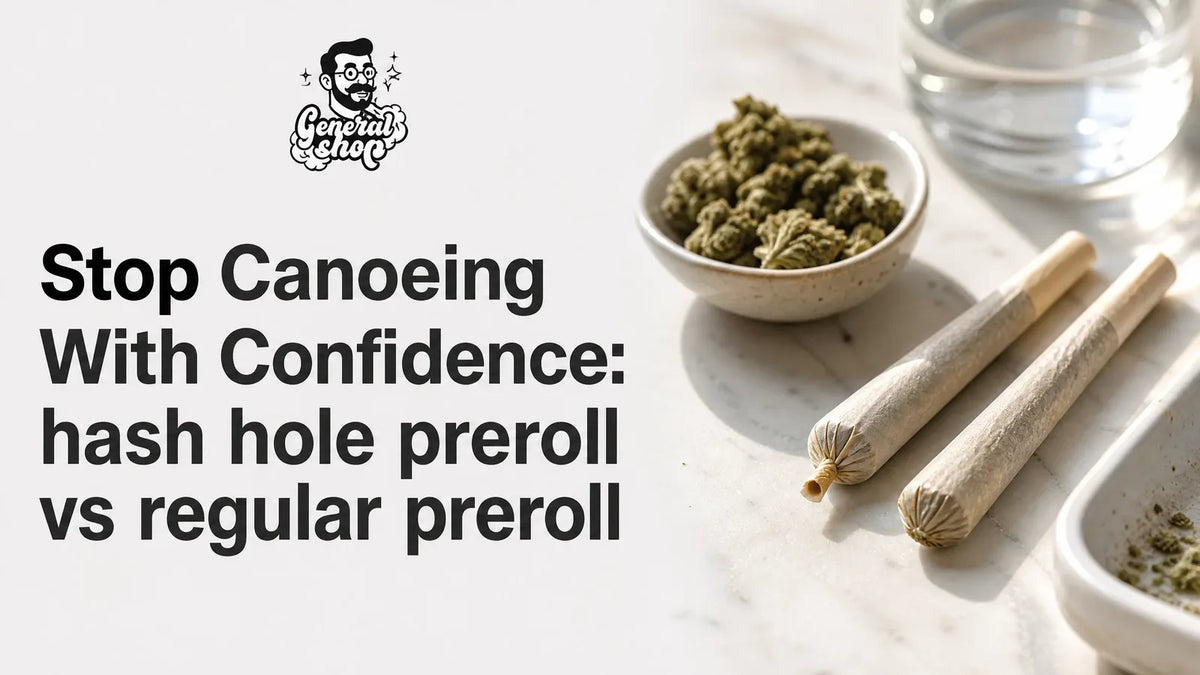
A hash hole preroll can be better for you than a regular preroll if you want a more intense session and you care about how the infusion is delivered as it burns. A regular preroll is the smarter pick if you are price-sensitive or you hate surprises like harsh smoke and canoeing.
Here’s what matters most right now:
- Hash hole preroll vs regular preroll comes down to core delivery vs uniform flower density.
- Hash hole prerolls often feel stronger, but poor construction can increase canoe risk.
- Judge value by cost per gram, not the pack price on the shelf.
- Freshness shows up in smoke quality first: stale prerolls taste harsh and burn unevenly.
- Your lighting technique matters: edge-light slowly and rotate to keep the burn even.
At General Shop, we carry multiple preroll formats and we push cost-per-gram comparisons because “premium” only counts when you can feel the difference in the burn. If you want a low-commitment first try of the hash hole preroll format, we point you to Hidden Hills Mini Mart Hash Hole Prerolls ($5.99) so you can test the core structure without overpaying.
Start by looking at the two formats side by side, then convert the price to cost per gram so you can judge value without guessing.
See the real differences fast, then judge value by cost per gram

The practical difference is structural: a hash hole preroll is built around a core feature meant to change how potency is delivered as it burns, while a regular preroll is uniform flower packed end to end. Strength usually follows that delivery, but the more important question is whether the burn and airflow are controlled enough to justify the premium.
One quick terminology warning before comparing: “hash hole” is sometimes used to describe a pipe bowl technique. This guide is only about finished, ready-to-smoke prerolls with an internal core structure.
Side by side: structure and intensity
A regular preroll is uniform ground flower with consistent density, so your session tends to ramp up gradually. A hash hole preroll is engineered around a core structure, which is why it can feel more “front-loaded” or wave-like as the heat reaches that center feature.
Expect intensity differences to show up as variability, not just a higher number on a label. With a uniform flower roll, you typically get a narrower range of effects from start to finish. With a core-based design, the experience can shift mid-session depending on how evenly the core warms and moves, which is why two pulls from the same joint can feel noticeably different.
Infusion delivery is the main variable: when the core is positioned and heated well, it can provide a more concentrated effect without needing to smoke more paper and flower. When it is uneven, you may get brief surges followed by flatter stretches, even if the total content is higher.
- Core structure (hash hole): internal cavity or centered feature intended to change how infusion and heat move through the roll
- Uniform flower (regular): consistent pack and material throughout, with fewer intensity swings
- Intensity expectation: more pronounced peaks are more likely with core-based construction, while regular rolls tend to feel steadier
- Terminology check: do not apply pipe “hash hole” language to prerolls, because the mechanisms are unrelated
Side by side: burn risk and harshness
Canoeing is usually a construction problem before it is a “you” problem. A regular preroll can still canoe, but the uniform density gives it fewer built-in failure points than a roll with a deliberate center feature.
With a hash hole build, hot spots tend to form where the core sits closer to one side or where the surrounding flower is packed looser. That concentrated heat can scorch the paper and create harsher hits early, even though the product is designed for a smoother, controlled melt when it is built correctly.
Airflow gives you an early clue. When draw resistance feels tight and inconsistent, the pack is often uneven; when it feels too loose, it can burn fast and run on one side. Regular prerolls often burn more predictably when you want a set-it-and-forget-it session, or when you are sensitive to harshness and do not want to troubleshoot an uneven core.
- Canoeing causes by construction: uneven density, loose edges, and asymmetry around the center feature
- Hot spots near core placement: one-sided core positioning or thin flower coverage can concentrate heat and increase harshness
- Draw resistance and airflow clues: tight and inconsistent usually signals uneven pack; overly airy often signals fast, uneven burn
- When regular burns more predictably: uniform flower and consistent density typically reduce mid-session surprises
Cost per gram beats pack price
To compare value fairly, start with cost per gram, not the pack price. The math is simple: price divided by total grams of finished preroll(s). Without the weight, you cannot make a clean comparison, even when two products look similar on the shelf.
Then compare within the same cannabinoid lane. A THC-A preroll priced against a THCP or terpene-forward HTE product is not a like-for-like decision, because you are paying for a different target experience. Once you are in the same lane, you can decide whether the extra spend is actually buying a better session or just a more complicated build.
The upcharge on a hash hole preroll is typically a construction premium: additional handling, tighter tolerances, and a more complex internal structure. Real value shows up when that construction improves consistency, burn control, and the way intensity is delivered, rather than just promising “stronger.”
- Compute it: cost per gram = price ÷ grams listed on the package
- Keep comparisons honest: evaluate products inside the same cannabinoid lane before judging “expensive” or “cheap”
- What you are paying for: labor and precision in the internal build, not just more material
- Spotting value without hype: prioritize clearly stated weight and a product description that explains the infusion delivery, not vague potency language
Avoid stale, harsh prerolls by checking freshness and build quality

The fastest way to regret a premium preroll is discovering it is dry, harsh, and built to burn unevenly. You can avoid most bad buys by checking freshness first, then confirming the roll is structurally sound before you ever light it.
Freshness cues that matter
Freshness shows up before the first spark: a preroll that smells muted and feels brittle is more likely to taste stale and burn hot. Strong aroma and a little give in the flower are practical signals that you are not paying for old material.
Aroma strength is the easiest screen. Smell the preroll before lighting, ideally near the tip: you are looking for clear, distinct scent rather than faint “paper and hay.” A well-made infused option can still smell flat if it has been stored poorly.
Feel the paper and the pack. The wrapper should feel intact and flexible, and the flower should have a slight spring when you gently squeeze, not a crunch. Dry product tends to combust faster, and cannabis industry analysis notes moisture content is the number one influencer of burn rate, with 3%-8% associated with the most desirable burn.
- Storage signs of dryness: cracked paper at the twist, a filter area that loosens easily, or bits shedding from the seam when handled
- Packaging cues: a bag or tube that is not well-sealed, or a preroll that was stored loose in a larger container
- Smell-proof bag usefulness: it helps slow odor loss and limits air exchange between sessions, which is especially helpful if you are not finishing the preroll the same day
Build cues that prevent canoeing
Canoeing usually starts with construction problems: uneven density, a crooked roll, or an infused core that is not centered. You can catch most of these issues with a visual check and one careful dry pull.
Start with density from tip to filter. You want a consistent pack that does not have soft pockets near the middle or a hard knot by the tip. Uneven density feeds one side more oxygen than the other, which encourages an uneven burn line.
Then inspect the roll. A straight cylinder with a firm seam is a better bet than a wrinkled wrapper or a seam that looks lifted. With a hash hole preroll, also look for a centered core line rather than a dark stripe sitting close to one side, since an off-axis core can melt and run unevenly.
- Even density: gently roll it between your fingers; it should feel consistent, not lumpy or hollow in sections
- Straight roll and firm seam: no obvious bends, no peeling edge, and no thin spot where the paper overlaps
- Core centered, not off-axis: the infused channel should track the middle, not hug the paper on one side
- Consistent airflow on the dry pull: take 1-2 light draws before lighting; it should feel open but not like sipping through a straw or pulling nothing at all
If you want a low-commitment way to test whether a hash hole-style core in a finished preroll is built cleanly, we often point first-time buyers to Hidden Hills Mini Mart Hash Hole Prerolls at $5.99 so the “does it burn right?” question gets answered without a big premium.
Use a three-step decision path to pick your session

Step 1: budget or premium session
Make the first decision about predictability versus enhanced delivery. Regular options are usually more straightforward: a consistent burn and a more familiar intensity curve when the flower is reasonably fresh.
A hash hole earns the upcharge when the reader is paying for the core structure and how it delivers the infusion through the session, not just a bigger number on a label. That extra construction can be the difference between a controlled, even experience and a messy one when the goal is a richer, heavier pull-by-pull effect.
Lower tolerance or shorter sessions generally pair better with regular, because the experience is easier to stop and set down. Higher tolerance or a longer sit-down session is where a premium format tends to feel “worth it,” because the core delivery has more time to show up.
- Stick to regular when: budget matters, surprises are unwelcome, or the plan is a quick smoke instead of a long session.
- Pay for a hash hole when: the goal is enhanced delivery and a more concentrated middle-to-late session, and the reader is comfortable with a stronger finish.
- Use tolerance as the tie-breaker: the higher the tolerance, the more likely the premium construction feels like a real upgrade rather than an unnecessary spike.
Step 2: choose a cannabinoid lane
Pick one cannabinoid lane before choosing the product format, because the cannabinoid choice is what sets the ceiling on intensity. Format changes delivery and burn behavior; cannabinoid choice changes how hard the session can hit.
THC-A is the classic-feel lane for readers who want a familiar experience and want to evaluate construction and burn without stacking the deck toward extreme potency. THCP is the highest intensity lane and is better treated as an experienced-user choice, because small changes in delivery can feel like large changes in effect.
HTE is the terpene-first lane, where the priority is aroma and flavor-forward character more than chasing maximum punch. Avoid mixing goals accidentally: pairing an “intensity lane” with a premium delivery format is how readers end up with a session that overshoots what they intended.
- THC-A lane: classic feel, easier to calibrate, good for comparing regular versus infused construction without surprise intensity.
- THCP lane: highest intensity, best reserved for readers who already know they tolerate strong sessions well.
- HTE lane: terpene-forward, best for flavor and aroma priorities rather than maximum potency.
- One clear goal per session: do not combine “highest intensity” and “most enhanced delivery” unless that is explicitly the plan.
Step 3: choose the format
After budget tier and cannabinoid lane are set, choose the format that matches that lane without creating a surprise jump in strength. Regular is the simple budget smoke: fewer variables, less chance of a session that escalates faster than intended.
A hash hole is the go-to when core delivery is the point, because the internal structure is built around how the infusion is experienced across the burn. A honey hole is an alternate core format that can scratch the same “infused core” itch for readers who want a different take on that delivery style.
Diamond infused options are the format choice for potency emphasis. Readers who want maximum intensity can pair that format with the appropriate lane, but the practical tradeoff is that potency-forward formats leave less room for error in pacing.
- Regular: best for predictable, budget-friendly sessions and shorter smoke windows.
- Hash hole: best when the reader is paying for core delivery and a more premium-feeling burn progression.
- Honey hole: best as an alternate core experience when the reader wants infused-core behavior without defaulting to the hash hole format.
- Diamond infused: best when potency is the primary objective, and the reader is comfortable pacing a stronger session.
Light and rotate the right way to stop uneven burns
The slow edge-light method
Uneven burn is usually a lighting error, not “bad infusion.” The fix is to start slow and heat the paper, not the core, so the burn line forms evenly before you take your first real pull.
- Hold the preroll at a slight angle so the flame meets the side, not the center of the tip.
- Toast only the outer edge of the paper until you see a thin, even ember ring.
- Rotate continuously while lighting so one spot never gets hotter than the rest.
- Avoid direct core heating, especially on core-based prerolls, because it can cause the center to run while the outside lags.
Mid-session fixes for canoeing
When one side starts racing, the worst move is to “power through” with bigger hits. Your goal is to slow the hot side down and let the cooler side catch up.
- Pause for a moment and let the cherry cool so it stops tunneling on the fast side.
- Use micro-rotations between pulls to keep heat distribution even as it burns.
- Take gentle puffs, not hard draws, because strong airflow can intensify the runaway edge.
- Tap ash lightly to rebalance the burn line by removing the heavier ash that can insulate one side.
Make the next preroll purchase based on burn quality, not hype
If you want the hash hole experience because you care about how the infusion is delivered as it burns, start small and controlled. We recommend beginning with Hidden Hills Mini Mart Hash Hole Prerolls at $5.99 so you can test the format without overcommitting, then comparing what you paid to what you actually smoked using cost per gram, not pack price.
If your priority is a simpler, budget-first session with fewer variables, choose a regular preroll and keep your standard routine. You will usually get a more predictable burn when you are not paying for a core structure.
If stale taste and dry pulls are your main concern, add a smell-proof bag so your prerolls stay fresher and more discreet between sessions.
Frequently Asked Questions
What is the main difference between hash hole preroll and regular preroll?
A hash hole preroll is built around a core structure that changes how the infusion and heat move through the joint. A regular preroll is a uniform flower fill without that internal core, which typically makes the session more straightforward and predictable.
Is hash hole preroll worth the extra cost compared to regular preroll?
It is worth it when you value the core delivery and the premium-style session enough to pay for the added construction. To keep the comparison fair, you should judge both formats by cost per gram and by burn performance, not by a bigger cannabinoid number alone.
Is 'hash hole preroll' the same as the hash hole on a hand pipe?
No. This guide is about finished, ready-to-smoke prerolls with an internal core structure. The pipe usage of the term refers to a different concept entirely and requires different techniques.


Leave a comment
This site is protected by hCaptcha and the hCaptcha Privacy Policy and Terms of Service apply.